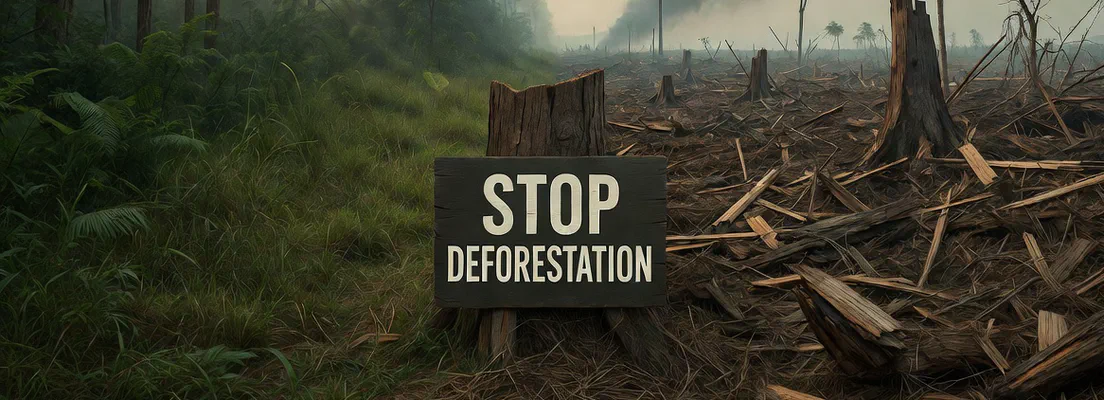
Information about deforestation, macro climate change, and local disasters that are currently rampant has encouraged me to publish an in-depth discussion on deforestation, from the economic benefits of forests/wood to global environmental impacts. Let’s try to compile all these ideas into this comprehensive article. I will explain in detail but casually, as if we were having coffee together at the campus forestry shop.
Let’s start with some basic facts: HGU (for example, for palm oil plantations or mining) and some of its areas include forest locations (plantation forests, secondary forests, and even primary natural forests; some sites are suspected of encroaching upon protected forests. The establishment of HGU in the field also often triggers land disputes with customary land).
After the HGU permit is issued, it is guaranteed that there will be a land clearing process; almost all the standing trees in the palm oil/mining planting area will be cut down. We all must wonder where those trees from the forest go? This is what we will discuss today: what is the potential wood from the forested land opened for palm oil/mining? Who benefits? Who loses? And why is this a significant issue today and a potential repeat in the future?
Estimating Wood Volume and Increment
In forestry science, the estimation of wood per hectare is based on measuring wood or mensuration. We use a simple formula like volume = cross-sectional area × height × form factor (usually 0.4-0.5 for tropical trees). But for large-scale assessments, we look at “standing stock” (the current wood stock available) and “increment” (annual volume growth).
For primary natural forests in Sumatra—like lowland dipterocarp in Riau, Jambi, or the newly opened natural forests in Aceh (still intact, never logged)—the commercial standing stock (wood with diameters ≥30-50 cm, species like meranti, keruing, bangkirai) averages 80-150 m³ per hectare. In the 1980s, it could reach up to 200 m³/ha from the best primary forests, but now it is rarely seen due to forest degradation. If we calculate the net, using a recovery factor of 60-80% (due to waste like branches, stumps, and damaged wood), it amounts to about 50-120 m³/ha that can be sold as round wood (logs).
A simple calculation: Imagine 100 ha of primary forest with a gross standing stock of 100 m³/ha. Net (70% recovery): 70 m³/ha × 100 ha = 7,000 m³ of round wood. This is often swept away during floods, like we saw in late 2025 in North Sumatra and Aceh—it is certain these are not naturally fallen trees, but logs from logging.
So, what is the annual increment in the tropical forests of Sumatra? It is low, only 1-4 m³/ha/year in unmanaged forests. With intensive silviculture like TPTI (Selective Logging and Planting Indonesia), it can rise to 5-10 m³/ha/year. This means that to be sustainable, we should only cut down as much as this annual increment per year to maintain stock. But the reality is harsh; many cut everything at once, then convert the land to monoculture.
Wood Prices and Economic Value Per Hectare
From a socioeconomic perspective, the value of wood becomes a significant magnet for exploitation. The price of round wood in Sumatra (2025) is fluctuating, depending on the type and quality. Meranti averages IDR 1,000,000-1,400,000/m³, keruing IDR 900,000-1,200,000/m³, and bangkirai is more premium at IDR 1,600,000-2,500,000/m³. Timber from mixed forests? Around IDR 700,000-1,000,000/m³. The overall average: IDR 1,000,000-1,200,000/m³ FOB logpond (at the logging site).
Calculating the value per hectare: Using a net standing stock of 70 m³/ha and an average price of IDR 1,100,000/m³, results in a gross of IDR 77 million/ha. Let’s take a safer average of IDR 100 million/ha—this is realistic for primary forests in Sumatra now. What remains after logging costs (30-50%), PSDH/DR (state contribution 10-15%), and taxes? A net balance of IDR 40-60 million/ha for the loggers.
For large-scale deforestation, like in Sumatra in 2024 (78,031 ha net according to KLHK), the potential loss of gross wood is IDR 7.8 trillion (78,031 ha × IDR 100 million/ha). This is clearly instant profit for those opening land! That’s why they are eager to invest in deforesting land at an alarming rate.
The Greedy Benefits of Land Clearing
Now, here’s the socioeconomic point that is disheartening. Many palm oil or mining companies (nickel/coal) in Sumatra are opening primary forests, and they are already making profits from the land clearing. The cost of clearing the land + planting oil palm until 3-4 years old? IDR 85-115 million/ha. But from the wood cut when opening the land, they already gain IDR 70-100 million/ha gross—immediate capital recovery before the palm oil is harvested, isn’t that crazy?
After that, mature oil palm provides IDR 40-60 million/ha/year (from FFB 20-25 tons/ha/year, with prices around IDR 2,000-3,000/kg). Total over 25 years: IDR 800 million - 1.2 billion/ha. This is why 97% of deforestation in 2024 was in legal concessions—profit is quick, planting oil palm seems almost without capital, just investments in permits. But the external costs (environmental & social impacts) are borne by local and global communities. Once a flash flood occurs in November-December 2025? The loss amounting to trillions: thousands of lives lost, houses destroyed, infrastructure damaged. If the disaster repeats, it’s quite greedy, right? A handful of elites who enjoy the profits while local communities pay dearly with their property and lives.
The Loss of Environmental Services and Climate Change
From a conservation perspective, forests are not just about wood; they are essential for the life support of all biological entities. The value of ecosystem services in tropical forests in Sumatra is around IDR 80-130 million/ha/year (from carbon absorption, water regulation, biodiversity, oxygen, etc.). Using an average figure of IDR 100 million/ha/year, the loss from deforestation in 2024 is: 78,031 ha × IDR 100 million = IDR 7.8 trillion/year—permanently!
The long-term impact of this loss is exponential. Deforestation in Sumatra (16 million ha of remaining cover, 33% of the island’s area) contributes to global climate change; the tangible proof: tropical cyclones are now daring to approach the equator! Cyclone Senyar (November 2025) in the Strait of Malacca (3-5° N), and Cyclone Bakung in the Indian Ocean—rare, due to weak Coriolis effect at the equator. The warming of the Indo-Pacific seas (due to emissions + forest loss) expands cyclone zones. The impacts of climate change are extreme flooding, landslides, and the loss of habitat for endemic species like orangutans, tigers, and Sumatran elephants. It affects not only humans but the entire web of global life—from soil microbes to bird migrations.
The forests of Sumatra are a divine gift: they absorb water to prevent flooding, maintain the climate, and provide homes for indigenous communities like the Orang Rimba. Cutting them down brutally means robbing the right to live for all biological beings in the world, not just as an inheritance for future generations.
Towards Sustainable Management
From wood measurement science to socioeconomic aspects, it is clear that the wood potential in Sumatra is high, even providing instant capital recovery for palm oil planters. Still, brutal unchecked exploitation leads to enormous losses. The solution? Narrow the space for corruption, collusion, and nepotism in related sectors (Agriculture, Forestry, Environment). Strengthen regulations like logging moratoriums, implement RIL (Reduced Impact Logging), and promote carbon credits/ecotourism as profitable alternatives. We need balance: yes to the economy, but conservation should be the priority. Otherwise, disasters like those in Sumatra in 2025 will become routine. Let’s all participate in preserving forests—from responsible consumption to supporting green policies.
Source:
- Kementerian Lingkungan Hidup dan Kehutanan (2025). Statistik Kehutanan Indonesia 2024
- Auriga Nusantara (2025). Laporan Deforestasi Sumatera 2024.
- Mongabay Indonesia (2025). Analisis Forest Loss di Sumatera.
- WALHI (Wahana Lingkungan Hidup Indonesia) (2025). Laporan Dampak Banjir Sumatera 2025 dan Deforestasi.
- The Economics of Ecosystems and Biodiversity (2010-2023). Valuation of Ecosystem Services.
- World Bank (2022). Indonesia Forest Valuation Study.
- IPCC (Intergovernmental Panel on Climate Change) (2023). AR6 Synthesis Report: Climate Change 2023 (untuk dampak siklon dan perubahan iklim).
- BMKG (Badan Meteorologi, Klimatologi, dan Geofisika) (2025). Laporan Siklon Tropis Senyar dan Bakung.
- Penelitian Kehutanan Lokal: Jurnal Hutan Tropis dan Forest Digest Indonesia (data riap dan standing stock, 2020-2025).
- Forum Pasar Kayu: Data harga dari supplier seperti KayuIndonesia.com dan laporan BPS (Badan Pusat Statistik) 2025.